> ## Documentation Index
> Fetch the complete documentation index at: https://portkey-docs-add-third-party-integration-issues-fixes.mintlify.site/llms.txt
> Use this file to discover all available pages before exploring further.

# LangGraph

> Use Portkey with LangGraph to take your AI agent workflows to production

## Introduction

LangGraph is a library for building stateful, multi-actor applications with LLMs, designed to make developing complex agent workflows easier. It provides a flexible framework to create directed graphs where nodes process information and edges define the flow between them.

Portkey enhances LangGraph with production-readiness features, turning your experimental agent workflows into robust systems by providing:

* **Complete observability** of every agent step, tool use, and state transition
* **Built-in reliability** with fallbacks, retries, and load balancing
* **Cost tracking and optimization** to manage your AI spend
* **Access to 1600+ LLMs** through a single integration
* **Guardrails** to keep agent behavior safe and compliant
* **Version-controlled prompts** for consistent agent performance

<Card title="LangGraph Official Documentation" icon="arrow-up-right-from-square" href="https://langchain-ai.github.io/langgraph/">
  Learn more about LangGraph's core concepts and features
</Card>

### Installation & Setup

<Steps>
  <Step title="Install the required packages">
    ```bash theme={null}
    pip install -U langgraph langchain langchain_openai portkey-ai
    ```

    Depending on your use case, you may also need additional packages:

    * For search capabilities: `pip install langchain_community`
    * For memory functionality: `pip install langgraph[checkpoint]`
  </Step>

  <Step title="Generate API Key" icon="lock">
    Create a Portkey API key with optional budget/rate limits from the [Portkey dashboard](https://app.portkey.ai/). You can attach configurations for reliability, caching, and more to this key.
  </Step>

  <Step title="Configure LangChain with Portkey">
    For a simple setup, configure a LangChain ChatOpenAI instance to use Portkey:

    ```python theme={null}
    from langchain_openai import ChatOpenAI
    from portkey_ai import createHeaders, PORTKEY_GATEWAY_URL

    # Set up LangChain model with Portkey
    llm = ChatOpenAI(
        api_key="dummy",  # This is just a placeholder
        base_url="https://api.portkey.ai/v1",
        default_headers=createHeaders(
            api_key="YOUR_PORTKEY_API_KEY",
            virtual_key="YOUR_PROVIDER_VIRTUAL_KEY",
            trace_id="unique-trace-id",               # Optional, for request tracing
            metadata={                                # Optional, for request segmentation
                "app_env": "production",
                "_user": "user_123"                   # Optional Special _user field for user analytics
            }
        )
    )
    ```

    <Info>
      **What are Virtual Keys?** Virtual keys in Portkey securely store your LLM provider API keys (OpenAI, Anthropic, etc.) in an encrypted vault. They allow for easier key rotation and budget management. [Learn more about virtual keys here](/product/ai-gateway/virtual-keys).
    </Info>
  </Step>
</Steps>

## Basic Agent Implementation

Let's create a simple LangGraph chatbot using Portkey. This example shows how to set up a basic conversational agent:

```python theme={null}
from typing import Annotated
from langchain_openai import ChatOpenAI
from typing_extensions import TypedDict
from portkey_ai import createHeaders
from langgraph.graph import StateGraph
from langgraph.graph.message import add_messages

# Define state structure with message history
class State(TypedDict):
    messages: Annotated[list, add_messages]

# Initialize graph builder
graph_builder = StateGraph(State)

# Set up LLM with Portkey
llm = ChatOpenAI(
    api_key="dummy",
    base_url="https://api.portkey.ai/v1",
    default_headers=createHeaders(
        api_key="YOUR_PORTKEY_API_KEY",
        virtual_key="YOUR_PROVIDER_VIRTUAL_KEY",
        trace_id="chat-session-123"  # Optional
    )
)

# Define chatbot node function
def chatbot(state: State):
    return {"messages": [llm.invoke(state["messages"])]}

# Add node to graph and set entry/exit points
graph_builder.add_node("chatbot", chatbot)
graph_builder.set_entry_point("chatbot")
graph_builder.set_finish_point("chatbot")
graph = graph_builder.compile()

# Function to handle streaming updates
def stream_graph_updates(user_input: str):
    for event in graph.stream({"messages": [{"role": "user", "content": user_input}]}):
        for value in event.values():
            print("Assistant:", value["messages"][-1].content)

# Interactive chat loop
while True:
    try:
        user_input = input("User: ")
        if user_input.lower() in ["quit", "exit", "q"]:
            print("Goodbye!")
            break
        stream_graph_updates(user_input)
    except Exception as e:
        print(f"Error: {e}")
        break
```

This basic implementation:

1. Creates a state graph with a message history
2. Configures a ChatOpenAI model with Portkey
3. Defines a simple chatbot node that processes messages with the LLM
4. Compiles the graph and provides a streaming interface for chat

## Advanced Features

### 1. Adding Tools to Your Agent

LangGraph can be enhanced with tools to allow your agent to perform actions. Here's how to add the Tavily search tool:

```python [expandable] theme={null}
from langgraph.prebuilt import ToolNode, tools_condition
from typing import Annotated
from langchain_openai import ChatOpenAI
from typing_extensions import TypedDict
from langgraph.graph import StateGraph
from langgraph.graph.message import add_messages
from portkey_ai import createHeaders
from langchain_community.tools.tavily_search import TavilySearchResults

class State(TypedDict):
    messages: Annotated[list, add_messages]

graph_builder = StateGraph(State)

# Initialize the Tavily search tool
# Note: Requires TAVILY_API_KEY environment variable or passed as argument
tool = TavilySearchResults(max_results=2)
tools = [tool]

# Set up LLM with Portkey
llm = ChatOpenAI(
    api_key="dummy",
    base_url="https://api.portkey.ai/v1",
    default_headers=createHeaders(
        api_key="YOUR_PORTKEY_API_KEY",
        virtual_key="YOUR_PROVIDER_VIRTUAL_KEY",
        trace_id="search-agent-session"  # Optional
    )
)
# Bind tools to the LLM
llm_with_tools = llm.bind_tools(tools)

def chatbot(state: State):
    return {"messages": [llm_with_tools.invoke(state["messages"])]}

graph_builder.add_node("chatbot", chatbot)

# Add tool node to handle tool execution
tool_node = ToolNode(tools=[tool])
graph_builder.add_node("tools", tool_node)

# Add conditional routing based on tool usage
graph_builder.add_conditional_edges(
    "chatbot",
    tools_condition,
)
# Return to chatbot after tool execution
graph_builder.add_edge("tools", "chatbot")
graph_builder.set_entry_point("chatbot")
graph = graph_builder.compile()
```

<Info>
  This example requires a Tavily API key for the search functionality. You can sign up for one at [Tavily's website](https://tavily.com/).
</Info>

### 2. Creating Custom Tools

You can create custom tools for your agents using the `@tool` decorator. Here's how to create a simple multiplication tool:

```python [expandable] theme={null}
from langchain_core.tools import tool
from pydantic import BaseModel, Field
from langgraph.prebuilt import ToolNode, tools_condition
from typing import Annotated
from langchain_openai import ChatOpenAI
from typing_extensions import TypedDict
from langgraph.graph import StateGraph
from langgraph.graph.message import add_messages
from portkey_ai import createHeaders

class State(TypedDict):
    messages: Annotated[list, add_messages]

# Define input schema for the tool
class MultiplyInputSchema(BaseModel):
    """Multiply two numbers"""
    a: int = Field(description="First operand")
    b: int = Field(description="Second operand")

# Create the tool
@tool("multiply_tool", args_schema=MultiplyInputSchema)
def multiply(a: int, b: int) -> int:
   return a * b

graph_builder = StateGraph(State)

tools = [multiply]

# Set up LLM with Portkey
llm = ChatOpenAI(
    api_key="dummy",
    base_url="https://api.portkey.ai/v1",
    default_headers=createHeaders(
        api_key="YOUR_PORTKEY_API_KEY",
        virtual_key="YOUR_PROVIDER_VIRTUAL_KEY",
    )
)
llm_with_tools = llm.bind_tools(tools)

def chatbot(state: State):
    return {"messages": [llm_with_tools.invoke(state["messages"])]}

graph_builder.add_node("chatbot", chatbot)
tool_node = ToolNode(tools=tools)
graph_builder.add_node("tools", tool_node)

graph_builder.add_conditional_edges(
    "chatbot",
    tools_condition,
)
graph_builder.add_edge("tools", "chatbot")
graph_builder.set_entry_point("chatbot")
graph = graph_builder.compile()
```

This example:

1. Defines a Pydantic model for the tool's input schema
2. Creates a custom multiplication tool with the `@tool` decorator
3. Integrates it into LangGraph with a tool node

### 3. Adding Memory to Your Agent

For persistent conversations, you can add memory to your LangGraph agents:

```python [expandable] theme={null}
from typing import Annotated
from langchain_openai import ChatOpenAI
from langchain_community.tools.tavily_search import TavilySearchResults
from typing_extensions import TypedDict
from portkey_ai import createHeaders
from langgraph.prebuilt import ToolNode, tools_condition
from langgraph.checkpoint.memory import MemorySaver
from langgraph.graph import StateGraph
from langgraph.graph.message import add_messages

class State(TypedDict):
    messages: Annotated[list, add_messages]

graph_builder = StateGraph(State)

# Set up tools and LLM with Portkey
tool = TavilySearchResults(max_results=2)
tools = [tool]
llm = ChatOpenAI(
    api_key="dummy",
    base_url="https://api.portkey.ai/v1",
    default_headers=createHeaders(
        api_key="YOUR_PORTKEY_API_KEY",
        virtual_key="YOUR_PROVIDER_VIRTUAL_KEY",
        trace_id="memory-agent-session"  # Optional
    )
)
llm_with_tools = llm.bind_tools(tools)

def chatbot(state: State):
    return {"messages": [llm_with_tools.invoke(state["messages"])]}

graph_builder.add_node("chatbot", chatbot)
tool_node = ToolNode(tools=[tool])
graph_builder.add_node("tools", tool_node)

graph_builder.add_conditional_edges(
    "chatbot",
    tools_condition,
)
graph_builder.add_edge("tools", "chatbot")
graph_builder.set_entry_point("chatbot")

# Initialize memory saver for persistent state
memory = MemorySaver()
graph = graph_builder.compile(checkpointer=memory)

# Configuration for memory thread id
config = {"configurable": {"thread_id": "1"}}

# Function to handle streaming updates with memory
def stream_graph_updates(user_input: str):
    events = graph.stream(
        {"messages": [{"role": "user", "content": user_input}]},
        config,
        stream_mode="values",
    )
    for event in events:
        if "messages" in event:
            # Use pretty_print method for better formatting
            event["messages"][-1].pretty_print()
```

<Info>
  The `thread_id` in the config allows you to maintain separate conversation threads for different users or contexts.
</Info>

## Production Features

### 1. Enhanced Observability

Portkey provides comprehensive observability for your LangGraph agents, helping you understand exactly what's happening during each execution.

<Tabs>
  <Tab title="Traces">
    <Frame>
      <img src="https://mintcdn.com/portkey-docs-add-third-party-integration-issues-fixes/9m2__JsviRgGAg35/images/product/product-11-1.webp?fit=max&auto=format&n=9m2__JsviRgGAg35&q=85&s=5178daa4c92c174a922d721a8d7acece" width="2224" height="1166" data-path="images/product/product-11-1.webp" />
    </Frame>

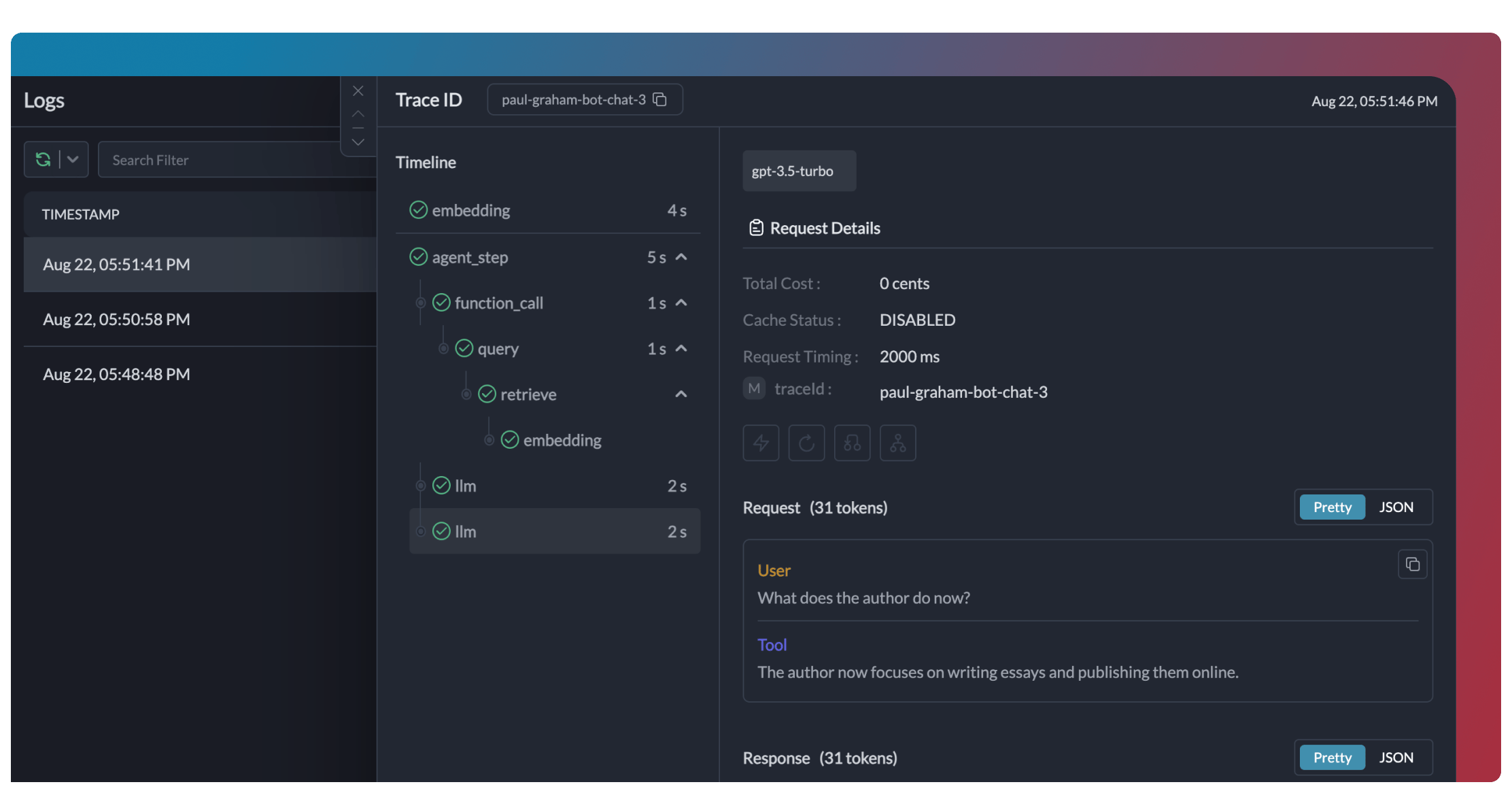
    Traces provide a hierarchical view of your agent's execution, showing the sequence of LLM calls, tool invocations, and state transitions.

    ```python theme={null}
    # Add trace_id to enable hierarchical tracing in Portkey
    llm = ChatOpenAI(
        api_key="dummy",
        base_url="https://api.portkey.ai/v1",
        default_headers=createHeaders(
            api_key="YOUR_PORTKEY_API_KEY",
            virtual_key="YOUR_LLM_PROVIDER_VIRTUAL_KEY",
            trace_id="unique-session-id",  # Add unique trace ID
            metadata={"request_type": "user_query"}
        )
    )
    ```

    LangGraph also offers its own tracing via LangSmith, which can be used alongside Portkey for even more detailed workflow insights.
  </Tab>

  <Tab title="Logs">
    <Frame>
      <img src="https://mintcdn.com/portkey-docs-add-third-party-integration-issues-fixes/9m2__JsviRgGAg35/images/product/product-2.avif?fit=max&auto=format&n=9m2__JsviRgGAg35&q=85&s=3fa6019c55913404359f113ed8f18773" width="2544" height="1602" data-path="images/product/product-2.avif" />
    </Frame>

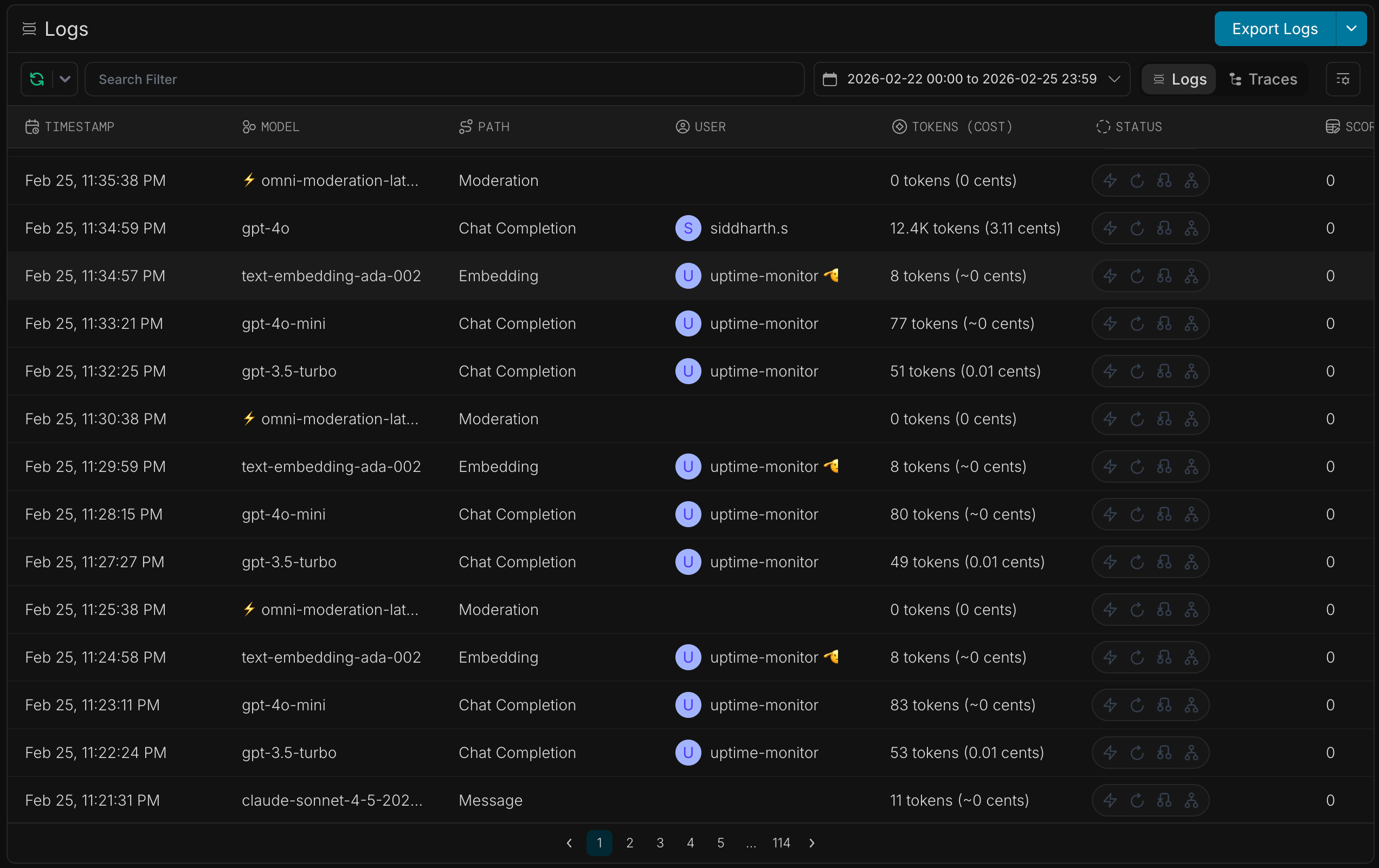
    Portkey logs every interaction with LLMs, including:

    * Complete request and response payloads
    * Latency and token usage metrics
    * Cost calculations
    * Tool calls and function executions

    All logs can be filtered by metadata, trace IDs, models, and more, making it easy to debug specific agent runs.
  </Tab>

  <Tab title="Metrics & Dashboards">
    <Frame>
      <img src="https://mintcdn.com/portkey-docs-add-third-party-integration-issues-fixes/9m2__JsviRgGAg35/images/product/dashboard.png?fit=max&auto=format&n=9m2__JsviRgGAg35&q=85&s=45f55655f4ba3429f1c1e3dbb1346c2c" width="1024" height="588" data-path="images/product/dashboard.png" />
    </Frame>

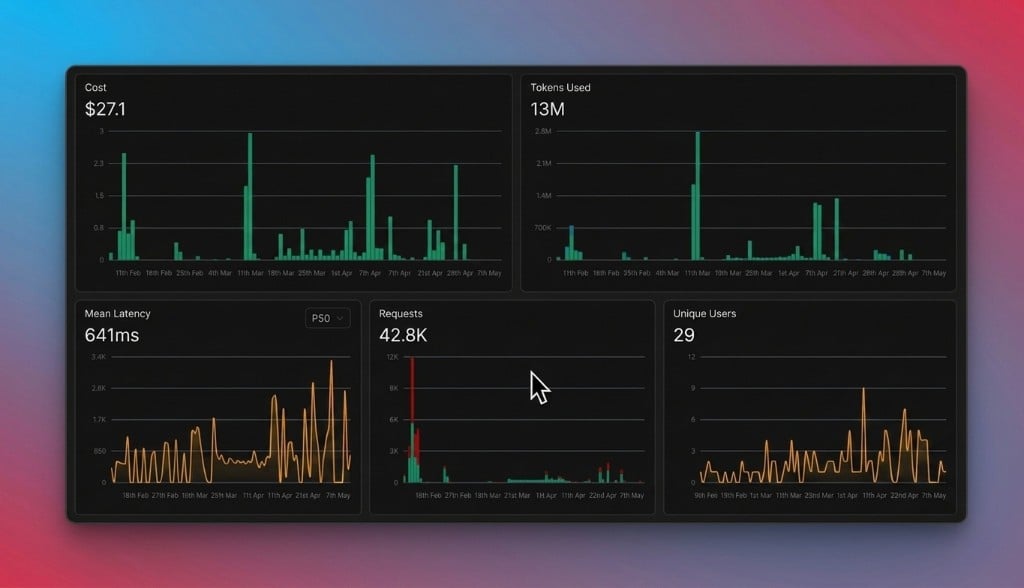
    Portkey provides built-in dashboards that help you:

    * Track cost and token usage across all agent runs
    * Analyze performance metrics like latency and success rates
    * Identify bottlenecks in your agent workflows
    * Compare different agent configurations and LLMs

    You can filter and segment all metrics by custom metadata to analyze specific agent types, user groups, or use cases.
  </Tab>

  <Tab title="Metadata Filtering">
    <Frame>
      <img src="https://mintcdn.com/portkey-docs-add-third-party-integration-issues-fixes/DY8m3zltb1T7tYmF/images/metadata.png?fit=max&auto=format&n=DY8m3zltb1T7tYmF&q=85&s=8ab50c317f25a5dc35a4c0b0888f59b5" alt="Analytics with metadata filters" width="1079" height="719" data-path="images/metadata.png" />
    </Frame>

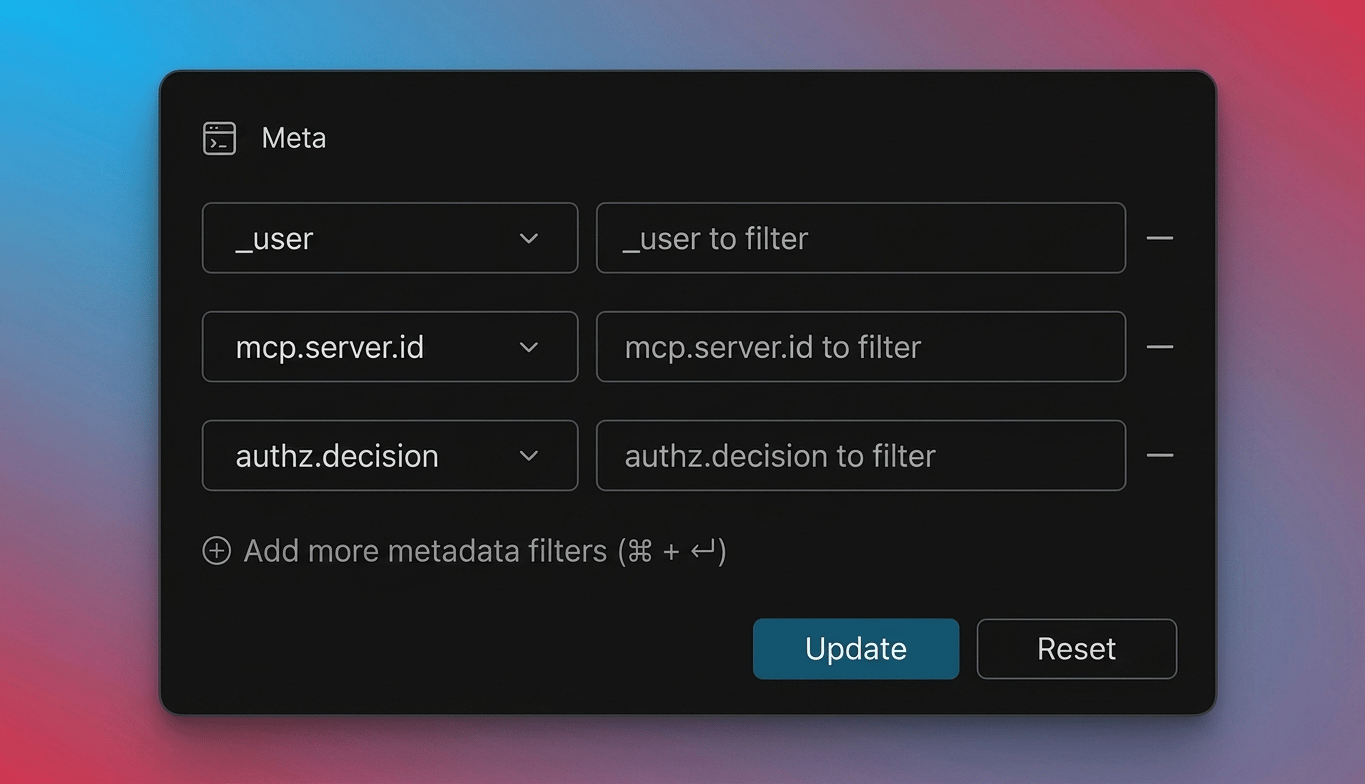
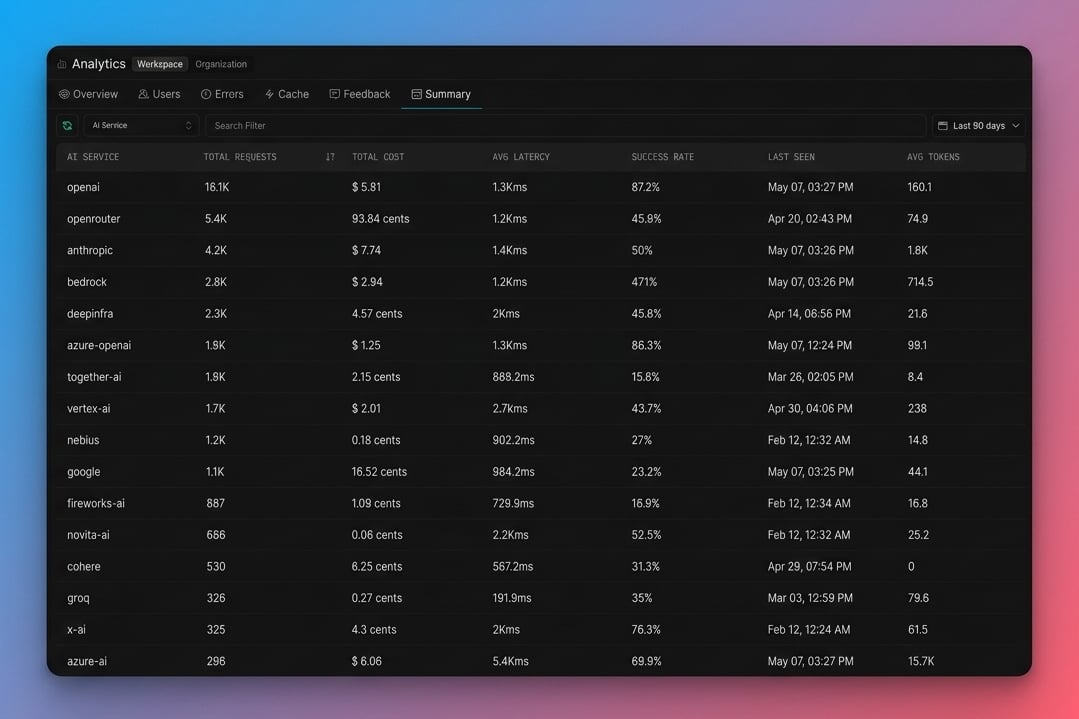
    Add custom metadata to your LangGraph agent calls to enable powerful filtering and segmentation:

    ```python theme={null}
    llm = ChatOpenAI(
        api_key="dummy",
        base_url="https://api.portkey.ai/v1",
        default_headers=createHeaders(
            api_key="YOUR_PORTKEY_API_KEY",
            virtual_key="YOUR_LLM_PROVIDER_VIRTUAL_KEY",
            metadata={
                "agent_type": "search_agent",
                "environment": "production",
                "_user": "user_123",   # Special _user field for user analytics
                "graph_id": "complex_workflow"
            }
        )
    )
    ```

    This metadata can be used to filter logs, traces, and metrics on the Portkey dashboard, allowing you to analyze specific agent runs, users, or environments.
  </Tab>
</Tabs>

### 2. Reliability - Keep Your Agents Running Smoothly

When running agents in production, things can go wrong - API rate limits, network issues, or provider outages. Portkey's reliability features ensure your agents keep running smoothly even when problems occur.

Enable fallback in your LangGraph agents by using a Portkey Config:

```python theme={null}
from portkey_ai import createHeaders

# Create LLM with fallback configuration
llm = ChatOpenAI(
    api_key="dummy",
    base_url="https://api.portkey.ai/v1",
    default_headers=createHeaders(
        api_key="YOUR_PORTKEY_API_KEY",
        config={
            "strategy": {
                "mode": "fallback"
            },
            "targets": [
                {
                    "virtual_key": "YOUR_OPENAI_VIRTUAL_API_KEY",
                    "override_params": {"model": "gpt-4o"}
                },
                {
                    "virtual_key": "YOUR_ANTHROPIC_VIRTUAL_API_KEY",
                    "override_params": {"model": "claude-3-opus-20240229"}
                }
            ]
        }
    )
)
```

This configuration will automatically try Claude if the GPT-4o request fails, ensuring your agent can continue operating.

<CardGroup cols="2">
  <Card title="Automatic Retries" icon="rotate" href="../../product/ai-gateway/automatic-retries">
    Handles temporary failures automatically. If an LLM call fails, Portkey will retry the same request for the specified number of times - perfect for rate limits or network blips.
  </Card>

  <Card title="Request Timeouts" icon="clock" href="../../product/ai-gateway/request-timeouts">
    Prevent your agents from hanging. Set timeouts to ensure you get responses (or can fail gracefully) within your required timeframes.
  </Card>

  <Card title="Conditional Routing" icon="route" href="../../product/ai-gateway/conditional-routing">
    Send different requests to different providers. Route complex reasoning to GPT-4, creative tasks to Claude, and quick responses to Gemini based on your needs.
  </Card>

  <Card title="Fallbacks" icon="shield" href="../../product/ai-gateway/fallbacks">
    Keep running even if your primary provider fails. Automatically switch to backup providers to maintain availability.
  </Card>

  <Card title="Load Balancing" icon="scale-balanced" href="../../product/ai-gateway/load-balancing">
    Spread requests across multiple API keys or providers. Great for high-volume agent operations and staying within rate limits.
  </Card>
</CardGroup>

### 3. Prompting in LangGraph

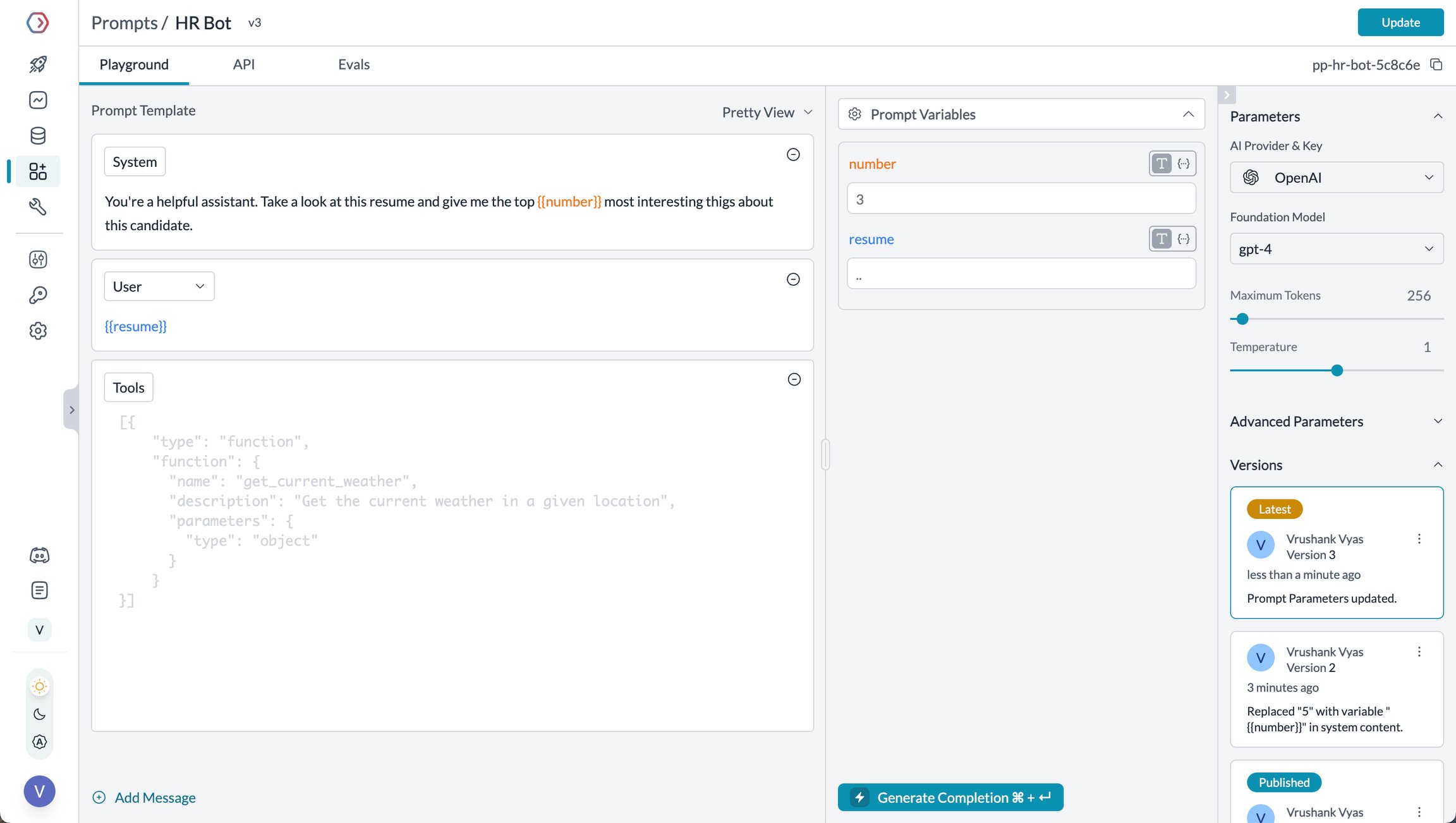
Portkey's Prompt Engineering Studio helps you create, manage, and optimize the prompts used in your LangGraph agents. Instead of hardcoding prompts or instructions, use Portkey's prompt rendering API to dynamically fetch and apply your versioned prompts.

<Frame caption="Manage prompts in Portkey's Prompt Library">
  <img src="https://mintcdn.com/portkey-docs-add-third-party-integration-issues-fixes/DY8m3zltb1T7tYmF/images/product/ai-gateway/ai-20.webp?fit=max&auto=format&n=DY8m3zltb1T7tYmF&q=85&s=83998c9ea0b8a0fb521d045195598ee8" alt="Prompt Playground Interface" width="2304" height="1302" data-path="images/product/ai-gateway/ai-20.webp" />
</Frame>

<Tabs>
  <Tab title="Prompt Playground">
    Prompt Playground is a place to compare, test and deploy perfect prompts for your AI application. It's where you experiment with different models, test variables, compare outputs, and refine your prompt engineering strategy before deploying to production. It allows you to:

    1. Iteratively develop prompts before using them in your agents
    2. Test prompts with different variables and models
    3. Compare outputs between different prompt versions
    4. Collaborate with team members on prompt development

    This visual environment makes it easier to craft effective prompts for each step in your LangGraph agent's workflow.
  </Tab>

  <Tab title="Using Prompt Templates">
    The Prompt Render API retrieves your prompt templates with all parameters configured:

    ```python theme={null}
    from portkey_ai import Portkey
    from langchain_openai import ChatOpenAI
    from portkey_ai import createHeaders

    # Initialize Portkey clients
    portkey_admin = Portkey(api_key="YOUR_PORTKEY_API_KEY")

    # Retrieve prompt using the render API
    prompt_data = portkey_admin.prompts.render(
        prompt_id="YOUR_PROMPT_ID",
        variables={
            "user_input": "Tell me about artificial intelligence"
        }
    ).data.dict()

    # Set up LLM with rendered system prompt
    llm = ChatOpenAI(
        api_key="dummy",
        base_url="https://api.portkey.ai/v1",
        default_headers=createHeaders(
            api_key="YOUR_PORTKEY_API_KEY",
            virtual_key="YOUR_OPENAI_VIRTUAL_KEY",
        )
    )

    # Define chatbot node with the rendered system prompt
    def chatbot(state):
        messages = state["messages"]
        # Add the system prompt from Portkey to the beginning of the conversation
        all_messages = [
            {"role": "system", "content": prompt_data["messages"][0]["content"]},
            *messages
        ]
        return {"messages": [llm.invoke(all_messages)]}
    ```
  </Tab>

  <Tab title="Prompt Versioning">
    You can:

    * Create multiple versions of the same prompt
    * Compare performance between versions
    * Roll back to previous versions if needed
    * Specify which version to use in your code:

    ```python theme={null}
    # Use a specific prompt version
    prompt_data = portkey_admin.prompts.render(
        prompt_id="YOUR_PROMPT_ID@version_number",
        variables={
            "user_input": "Tell me about quantum computing"
        }
    )
    ```
  </Tab>

  <Tab title="Mustache Templating for variables">
    Portkey prompts use Mustache-style templating for easy variable substitution:

    ```
    You are an AI assistant specialized in {{agent_role}}.

    User question: {{user_input}}

    Please respond in a {{tone}} tone and include {{required_elements}}.
    ```

    When rendering, simply pass the variables:

    ```python theme={null}
    prompt_data = portkey_admin.prompts.render(
        prompt_id="YOUR_PROMPT_ID",
        variables={
            "agent_role": "search navigator",
            "user_input": "Find information about climate change",
            "tone": "informative",
            "required_elements": "recent scientific findings"
        }
    )
    ```
  </Tab>
</Tabs>

<Card title="Prompt Engineering Studio" icon="wand-magic-sparkles" href="/product/prompt-library">
  Learn more about Portkey's prompt management features
</Card>

### 4. Guardrails for Safe Agents

Guardrails ensure your LangGraph agents operate safely and respond appropriately in all situations.

**Why Use Guardrails?**

LangGraph agents can experience various failure modes:

* Generating harmful or inappropriate content
* Leaking sensitive information like PII
* Hallucinating incorrect information
* Generating outputs in incorrect formats

Portkey's guardrails add protection for both inputs and outputs.

**Implementing Guardrails**

```python theme={null}
from langchain_openai import ChatOpenAI
from portkey_ai import createHeaders

# Create LLM with guardrails
llm = ChatOpenAI(
    api_key="dummy",
    base_url="https://api.portkey.ai/v1",
    default_headers=createHeaders(
        api_key="YOUR_PORTKEY_API_KEY",
        virtual_key="YOUR_OPENAI_VIRTUAL_KEY",
        config={
            "input_guardrails": ["guardrails-id-xxx", "guardrails-id-yyy"],
            "output_guardrails": ["guardrails-id-zzz"]
        }
    )
)
```

Portkey's guardrails can:

* Detect and redact PII in both inputs and outputs
* Filter harmful or inappropriate content
* Validate response formats against schemas
* Check for hallucinations against ground truth
* Apply custom business logic and rules

<Card title="Learn More About Guardrails" icon="shield-check" href="/product/guardrails">
  Explore Portkey's guardrail features to enhance agent safety
</Card>

### 5. User Tracking with Metadata

Track individual users through your LangGraph agents using Portkey's metadata system.

**What is Metadata in Portkey?**

Metadata allows you to associate custom data with each request, enabling filtering, segmentation, and analytics. The special `_user` field is specifically designed for user tracking.

```python theme={null}
from langchain_openai import ChatOpenAI
from portkey_ai import createHeaders

# Configure LLM with user tracking
llm = ChatOpenAI(
    api_key="dummy",
    base_url="https://api.portkey.ai/v1",
    default_headers=createHeaders(
        api_key="YOUR_PORTKEY_API_KEY",
        virtual_key="YOUR_OPENAI_VIRTUAL_KEY",
        metadata={
            "_user": "user_123",  # Special _user field for user analytics
            "user_tier": "premium",
            "user_company": "Acme Corp",
            "session_id": "abc-123",
            "graph_id": "search_workflow"
        }
    )
)
```

**Filter Analytics by User**

With metadata in place, you can filter analytics by user and analyze performance metrics on a per-user basis:

<Frame caption="Filter analytics by user">
  <img src="https://mintcdn.com/portkey-docs-add-third-party-integration-issues-fixes/DY8m3zltb1T7tYmF/images/metadata-filters.png?fit=max&auto=format&n=DY8m3zltb1T7tYmF&q=85&s=4a83011c394dfdf99ac7f329436ea751" width="1365" height="784" data-path="images/metadata-filters.png" />
</Frame>

This enables:

* Per-user cost tracking and budgeting
* Personalized user analytics
* Team or organization-level metrics
* Environment-specific monitoring (staging vs. production)
<Card title="Learn More About Metadata" icon="tags" href="/product/observability/metadata">
  Explore how to use custom metadata to enhance your analytics
</Card>

### 6. Caching for Efficient Agents

Implement caching to make your LangGraph agents more efficient and cost-effective:

<Tabs>
  <Tab title="Simple Caching">
    ```python theme={null}
    from langchain_openai import ChatOpenAI
    from portkey_ai import createHeaders

    # Configure LLM with simple caching
    llm = ChatOpenAI(
        api_key="dummy",
        base_url="https://api.portkey.ai/v1",
        default_headers=createHeaders(
            api_key="YOUR_PORTKEY_API_KEY",
            virtual_key="YOUR_OPENAI_VIRTUAL_KEY",
            config={
                "cache": {
                    "mode": "simple"
                }
            }
        )
    )
    ```

    Simple caching performs exact matches on input prompts, caching identical requests to avoid redundant model executions.
  </Tab>

  <Tab title="Semantic Caching">
    ```python theme={null}
    from langchain_openai import ChatOpenAI
    from portkey_ai import createHeaders

    # Configure LLM with semantic caching
    llm = ChatOpenAI(
        api_key="dummy",
        base_url="https://api.portkey.ai/v1",
        default_headers=createHeaders(
            api_key="YOUR_PORTKEY_API_KEY",
            virtual_key="YOUR_OPENAI_VIRTUAL_KEY",
            config={
                "cache": {
                    "mode": "semantic"
                }
            }
        )
    )
    ```

    Semantic caching considers the contextual similarity between input requests, caching responses for semantically similar inputs.
  </Tab>
</Tabs>

### 7. Model Interoperability

LangGraph works with multiple LLM providers, and Portkey extends this capability by providing access to over 200 LLMs through a unified interface. You can easily switch between different models without changing your core agent logic:

```python theme={null}
from langchain_openai import ChatOpenAI
from portkey_ai import createHeaders

# OpenAI configuration
openai_llm = ChatOpenAI(
    api_key="dummy",
    base_url="https://api.portkey.ai/v1",
    default_headers=createHeaders(
        api_key="YOUR_PORTKEY_API_KEY",
        virtual_key="YOUR_OPENAI_VIRTUAL_KEY"
    )
)

# Anthropic configuration
anthropic_llm = ChatOpenAI(
    api_key="dummy",
    base_url="https://api.portkey.ai/v1",
    default_headers=createHeaders(
        api_key="YOUR_PORTKEY_API_KEY",
        virtual_key="YOUR_ANTHROPIC_VIRTUAL_KEY"
    )
)

# Choose which LLM to use based on your needs
active_llm = openai_llm  # or anthropic_llm

# Use in your LangGraph nodes
def chatbot(state):
    return {"messages": [active_llm.invoke(state["messages"])]}
```

Portkey provides access to LLMs from providers including:

* OpenAI (GPT-4o, GPT-4 Turbo, etc.)
* Anthropic (Claude 3.5 Sonnet, Claude 3 Opus, etc.)
* Mistral AI (Mistral Large, Mistral Medium, etc.)
* Google Vertex AI (Gemini 1.5 Pro, etc.)
* Cohere (Command, Command-R, etc.)
* AWS Bedrock (Claude, Titan, etc.)
* Local/Private Models

<Card title="Supported Providers" icon="server" href="/integrations/llms">
  See the full list of LLM providers supported by Portkey
</Card>

## Set Up Enterprise Governance for LangGraph

**Why Enterprise Governance?**
If you are using LangGraph inside your organization, you need to consider several governance aspects:

* **Cost Management**: Controlling and tracking AI spending across teams
* **Access Control**: Managing which teams can use specific models
* **Usage Analytics**: Understanding how AI is being used across the organization
* **Security & Compliance**: Maintaining enterprise security standards
* **Reliability**: Ensuring consistent service across all users

Portkey adds a comprehensive governance layer to address these enterprise needs. Let's implement these controls step by step.

<Steps>
  <Step title="Create Virtual Key">
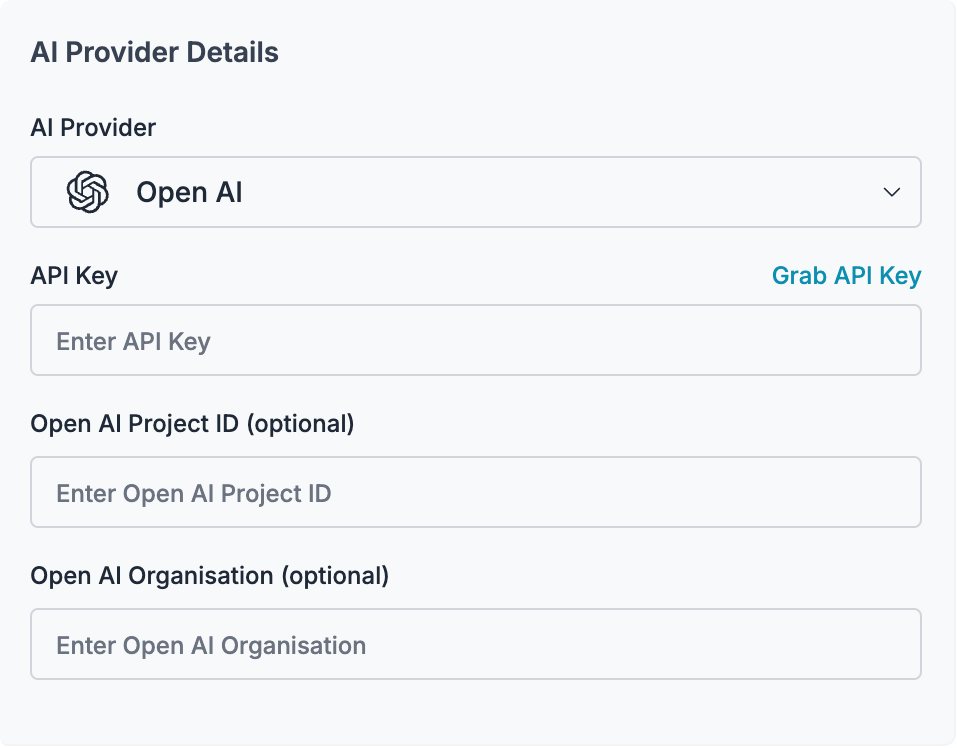
    Virtual Keys are Portkey's secure way to manage your LLM provider API keys. They provide essential controls like:

    * Budget limits for API usage
    * Rate limiting capabilities
    * Secure API key storage

    To create a virtual key:
    Go to [Virtual Keys](https://app.portkey.ai/virtual-keys) in the Portkey App. Save and copy the virtual key ID

    <Frame>
      <img src="https://mintcdn.com/portkey-docs-add-third-party-integration-issues-fixes/iw8u5vDH8VX-5kWU/images/integrations/openai/virtual-key-2.png?fit=max&auto=format&n=iw8u5vDH8VX-5kWU&q=85&s=a8c33fd72639726334d697df5a9b5701" width="500" data-path="images/integrations/openai/virtual-key-2.png" />
    </Frame>

    <Note>
      Save your virtual key ID - you'll need it for the next step.
    </Note>
  </Step>

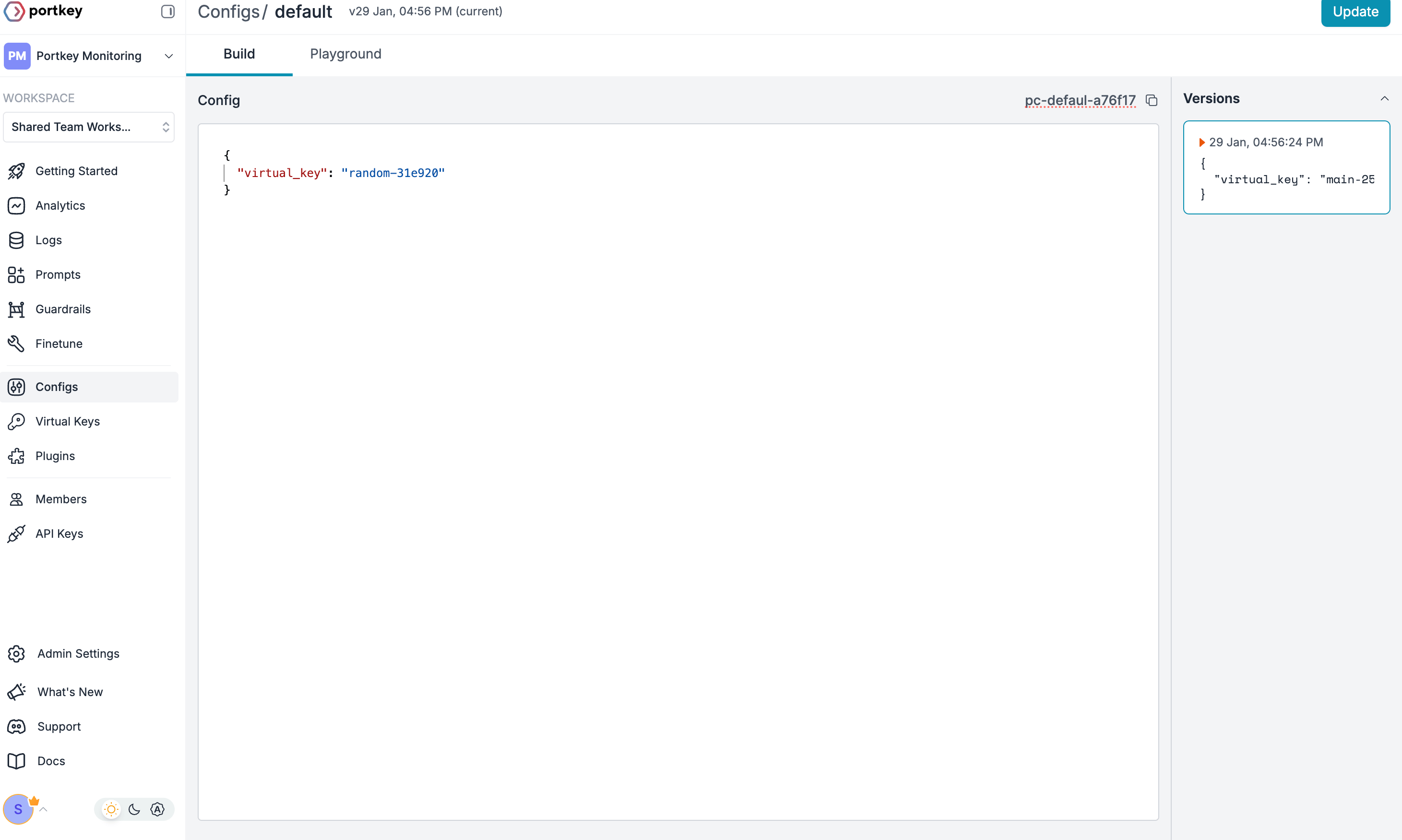
  <Step title="Create Default Config">
    Configs in Portkey define how your requests are routed, with features like advanced routing, fallbacks, and retries.

    To create your config:

    1. Go to [Configs](https://app.portkey.ai/configs) in Portkey dashboard
    2. Create new config with:
       ```json theme={null}
       {
           "virtual_key": "YOUR_VIRTUAL_KEY_FROM_STEP1",
          	"override_params": {
             "model": "gpt-4o" // Your preferred model name
           }
       }
       ```
    3. Save and note the Config name for the next step

    <Frame>
      <img src="https://mintcdn.com/portkey-docs-add-third-party-integration-issues-fixes/iw8u5vDH8VX-5kWU/images/integrations/config.png?fit=max&auto=format&n=iw8u5vDH8VX-5kWU&q=85&s=4f064fb3d8747631ac100fc2c51a8db6" width="500" data-path="images/integrations/config.png" />
    </Frame>
  </Step>

  <Step title="Configure Portkey API Key">
    Now create a Portkey API key and attach the config you created in Step 2:

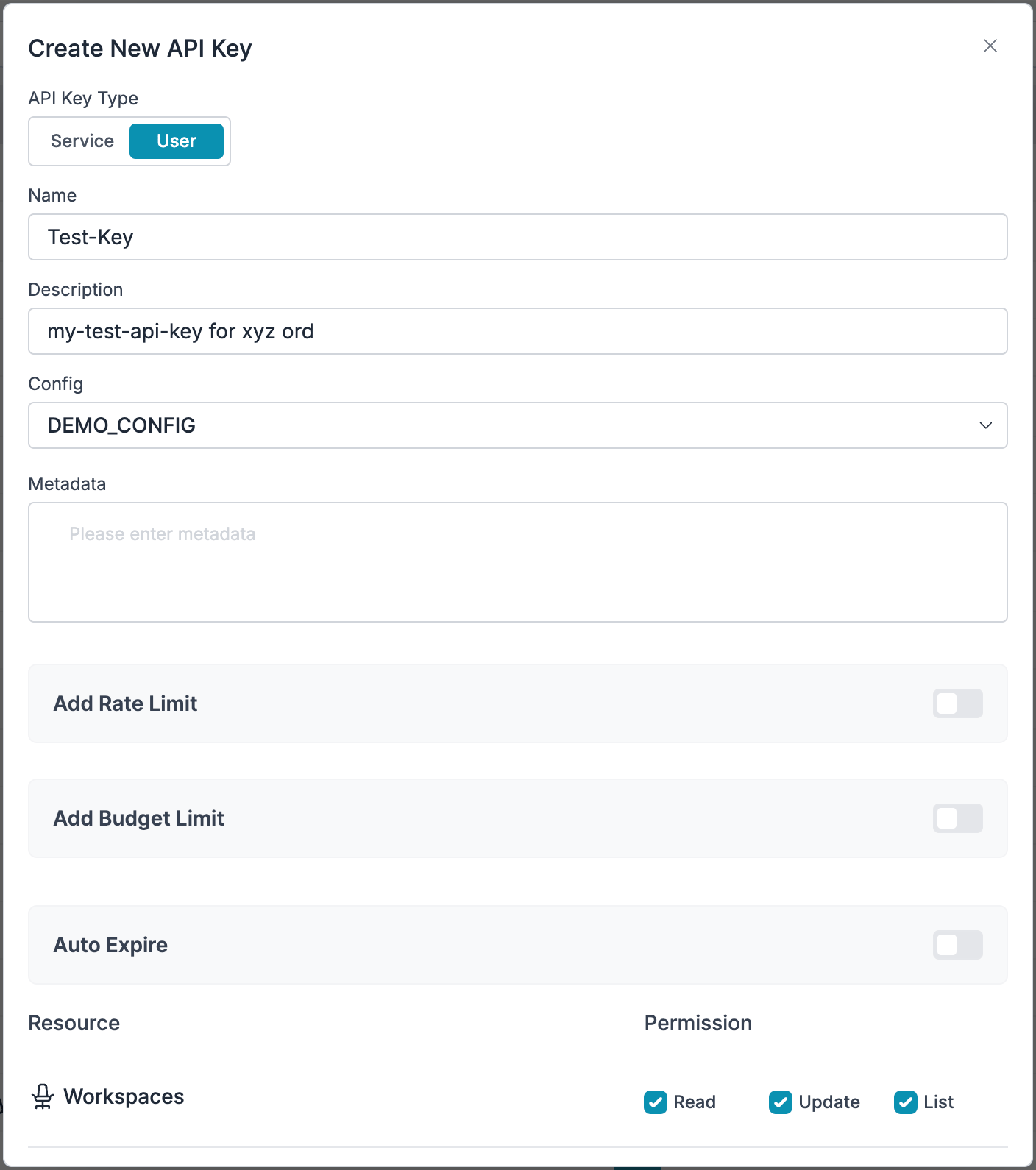
    1. Go to [API Keys](https://app.portkey.ai/api-keys) in Portkey and Create new API key
    2. Select your config from `Step 2`
    3. Generate and save your API key

    <Frame>
      <img src="https://mintcdn.com/portkey-docs-add-third-party-integration-issues-fixes/iw8u5vDH8VX-5kWU/images/integrations/api-key.png?fit=max&auto=format&n=iw8u5vDH8VX-5kWU&q=85&s=989d12de9518c2d6a263d966f5ce5897" width="500" data-path="images/integrations/api-key.png" />
    </Frame>
  </Step>

  <Step title="Connect to LangGraph">
    After setting up your Portkey API key with the attached config, connect it to your LangGraph agents:

    ```python theme={null}
    from langchain_openai import ChatOpenAI
    from portkey_ai import createHeaders

    # Configure LLM with your Portkey API key
    llm = ChatOpenAI(
        api_key="dummy",
        base_url="https://api.portkey.ai/v1",
        default_headers=createHeaders(
            api_key="YOUR_PORTKEY_API_KEY"  # The API key with attached config from step 3
        )
    )
    ```
  </Step>
</Steps>

<AccordionGroup>
  <Accordion title="Step 1: Implement Budget Controls & Rate Limits">
    ### Step 1: Implement Budget Controls & Rate Limits

    Virtual Keys enable granular control over LLM access at the team/department level. This helps you:

    * Set up [budget limits](/product/ai-gateway/virtual-keys/budget-limits)
    * Prevent unexpected usage spikes using Rate limits
    * Track departmental spending

    #### Setting Up Department-Specific Controls:

    1. Navigate to [Virtual Keys](https://app.portkey.ai/virtual-keys) in Portkey dashboard
    2. Create new Virtual Key for each department with budget limits and rate limits
    3. Configure department-specific limits

    <Frame>
      <img src="https://mintcdn.com/portkey-docs-add-third-party-integration-issues-fixes/iw8u5vDH8VX-5kWU/images/integrations/openai/virtual-key-2.png?fit=max&auto=format&n=iw8u5vDH8VX-5kWU&q=85&s=a8c33fd72639726334d697df5a9b5701" width="500" data-path="images/integrations/openai/virtual-key-2.png" />
    </Frame>
  </Accordion>

  <Accordion title="Step 2: Define Model Access Rules">
    ### Step 2: Define Model Access Rules

    As your AI usage scales, controlling which teams can access specific models becomes crucial. Portkey Configs provide this control layer with features like:

    #### Access Control Features:

    * **Model Restrictions**: Limit access to specific models
    * **Data Protection**: Implement guardrails for sensitive data
    * **Reliability Controls**: Add fallbacks and retry logic

    #### Example Configuration:

    Here's a basic configuration to route requests to OpenAI, specifically using GPT-4o:

    ```json theme={null}
    {
    	"strategy": {
    		"mode": "single"
    	},
    	"targets": [
    		{
    			"virtual_key": "YOUR_OPENAI_VIRTUAL_KEY",
    			"override_params": {
    				"model": "gpt-4o"
    			}
    		}
    	]
    }
    ```

    Create your config on the [Configs page](https://app.portkey.ai/configs) in your Portkey dashboard.

    <Note>
      Configs can be updated anytime to adjust controls without affecting running applications.
    </Note>
  </Accordion>

  <Accordion title="Step 3: Implement Access Controls">
    ### Step 3: Implement Access Controls

    Create User-specific API keys that automatically:

    * Track usage per user/team with the help of virtual keys
    * Apply appropriate configs to route requests
    * Collect relevant metadata to filter logs
    * Enforce access permissions

    Create API keys through:

    * [Portkey App](https://app.portkey.ai/)
    * [API Key Management API](/api-reference/admin-api/control-plane/api-keys/create-api-key)

    Example using Python SDK:

    ```python theme={null}
    from portkey_ai import Portkey

    portkey = Portkey(api_key="YOUR_ADMIN_API_KEY")

    api_key = portkey.api_keys.create(
        name="engineering-team",
        type="organisation",
        workspace_id="YOUR_WORKSPACE_ID",
        defaults={
            "config_id": "your-config-id",
            "metadata": {
                "environment": "production",
                "department": "engineering"
            }
        },
        scopes=["logs.view", "configs.read"]
    )
    ```

    For detailed key management instructions, see our [API Keys documentation](/api-reference/admin-api/control-plane/api-keys/create-api-key).
  </Accordion>

  <Accordion title="Step 4: Deploy & Monitor">
    ### Step 4: Deploy & Monitor

    After distributing API keys to your team members, your enterprise-ready LangGraph setup is ready to go. Each team member can now use their designated API keys with appropriate access levels and budget controls.

    Monitor usage in Portkey dashboard:

    * Cost tracking by department
    * Model usage patterns
    * Request volumes
    * Error rates
  </Accordion>
</AccordionGroup>

<Note>
  ### Enterprise Features Now Available

  **Your LangGraph integration now has:**

  * Departmental budget controls
  * Model access governance
  * Usage tracking & attribution
  * Security guardrails
  * Reliability features
</Note>

## Frequently Asked Questions

<AccordionGroup>
  <Accordion title="How does Portkey enhance LangGraph?">
    Portkey adds production-readiness to LangGraph through comprehensive observability (traces, logs, metrics), reliability features (fallbacks, retries, caching), and access to 1600+ LLMs through a unified interface. This makes it easier to debug, optimize, and scale your agent workflows.
  </Accordion>

  <Accordion title="Can I use Portkey with existing LangGraph applications?">
    Yes! Portkey integrates seamlessly with existing LangGraph applications. You just need to replace your LLM initialization code with the Portkey-enabled version. The rest of your graph code remains unchanged.
  </Accordion>

  <Accordion title="Does Portkey work with all LangGraph features?">
    Portkey supports all LangGraph features, including tools, memory, conditional routing, and complex multi-node workflows. It adds observability and reliability without limiting any of the framework's functionality.
  </Accordion>

  <Accordion title="How do I filter logs and traces for specific graph runs?">
    Portkey allows you to add custom metadata and trace IDs to your LLM calls, which you can then use for filtering. Add fields like `graph_id`, `workflow_type`, or `session_id` to easily find and analyze specific graph executions.
  </Accordion>

  <Accordion title="Can I use LangGraph's memory features with Portkey?">
    Yes! The examples in this documentation show how to use LangGraph's `MemorySaver` checkpointer with Portkey-enabled LLMs. All the memory and state management features work seamlessly with Portkey.
  </Accordion>
</AccordionGroup>

## Resources

<CardGroup cols="3">
  <Card title="LangGraph Docs" icon="book" href="https://langchain-ai.github.io/langgraph/">
    <p>Official LangGraph documentation</p>
  </Card>

  <Card title="Portkey Docs" icon="book" href="https://portkey.ai/docs">
    <p>Official Portkey documentation</p>
  </Card>

  <Card title="Book a Demo" icon="calendar" href="https://calendly.com/portkey-ai">
    <p>Get personalized guidance on implementing this integration</p>
  </Card>
</CardGroup>